The Science

The science begins after you swallow.

An ingredient appearing on a label does not mean it will reach the place where it needs to work. First the tablet or capsule must release its contents. Then the ingredient must survive the digestive environment, reach the correct part of the body, and either cross the intestinal barrier or perform its function inside the gut. That entire journey — not merely the ingredient list — is what we design for.

Absorption is not one event.

For a mineral such as magnesium, success means becoming soluble, crossing the intestinal wall and becoming available for use throughout the body.

For a gut-health formula, success can mean something completely different. A probiotic, prebiotic or digestive enzyme may perform most of its function inside the digestive tract, without entering the bloodstream. That distinction is central to the science behind AIM.

The AIM pathway

  1. 1
    Release

    Does the tablet or capsule break down properly?

  2. 2
    Survival

    Can the ingredient withstand moisture, stomach acid, digestive enzymes and storage?

  3. 3
    Arrival

    Does it reach the part of the digestive system where it is intended to act?

  4. 4
    Absorption or local action

    Does it cross the intestinal wall — or perform its job inside the gut?

  5. 5
    Utilisation

    Can the body or microbiome meaningfully use what arrives?

Digestion and absorption involve several separate stages, with nutrients generally broken down before they can be absorbed and used. NIDDK

Absorption may begin quickly. Meaningful changes usually require consistency. "Absorbed In Minutes" is not a promise that every person will feel a result in minutes.

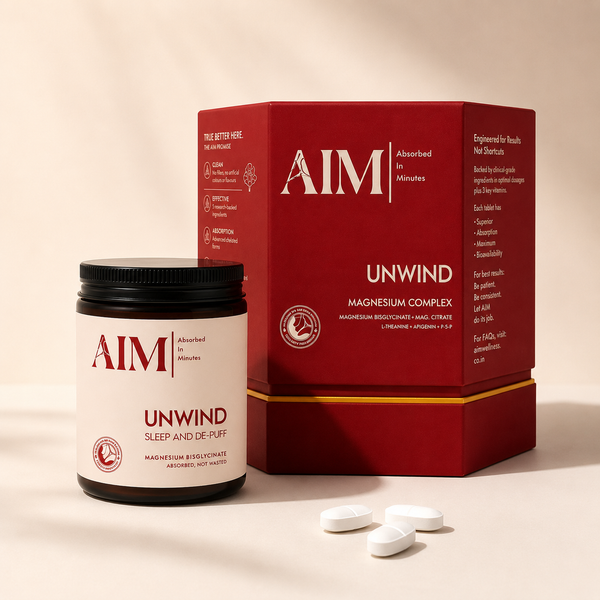
UNWIND

From mineral salt to cellular cofactor

Magnesium is not swallowed as isolated magnesium. It must be attached to another molecule to create a stable magnesium compound. That companion molecule affects how easily the magnesium dissolves, how it behaves in the digestive tract and how much remains available for intestinal absorption.

UNWIND uses magnesium bisglycinate and magnesium citrate rather than relying on poorly soluble magnesium oxide. Research and official nutrition guidance support the broader conclusion that forms which dissolve well — such as citrate — tend to be more bioavailable than magnesium oxide. However, no responsible formulation can promise one fixed absorption percentage for every person, because absorption also changes with dose, diet, magnesium status and individual physiology. NIH Office of Dietary Supplements

What happens after UNWIND is taken

  1. 1
    The tablet releases its ingredients

    The magnesium compounds must first disintegrate and dissolve in gastrointestinal fluid. A large elemental-magnesium number on a label does not, by itself, establish absorption.

  2. 2
    Magnesium crosses the intestinal wall

    Magnesium is taken up through regulated intestinal pathways. The body can alter absorption and kidney retention depending on how much is consumed and how much is already available.

  3. 3
    Magnesium becomes part of normal physiology

    Once available, magnesium serves as a cofactor in more than 300 enzyme systems — energy production, nerve signalling, muscle function, protein synthesis and electrolyte transport. ODS

  4. 4
    The evening formula supports — not overrides — the nervous system

    UNWIND is not intended to switch consciousness off like a sedative. It is designed to support the physiological conditions involved in winding down.

Human evidence on magnesium and sleep is encouraging but not absolute. A 2025 placebo-controlled trial of magnesium bisglycinate reported a modest improvement in insomnia severity after four weeks, while earlier reviews found magnesium trials produced mixed results. PubMed

L-theanine has separate human evidence relating to relaxation and sleep quality, with most sleep research examining approximately 200–450 mg per day. Apigenin has a plausible biological rationale, but direct clinical evidence for isolated apigenin as a sleep ingredient is much more limited than the marketing around it often suggests. PubMed

Why UNWIND contains more than magnesium

Magnesium bisglycinate

A chelated form selected for solubility, gastrointestinal tolerance and its emerging human sleep evidence.

Magnesium citrate

A soluble magnesium form that contributes to total magnesium availability.

L-theanine

Included for relaxed attention and evening calm — not as a pharmaceutical sedative.

Apigenin

A plant flavonoid included on the basis of mechanistic and botanical evidence. We distinguish that evidence from finished-product clinical proof.

P-5-P

The coenzyme form of vitamin B6, included to support normal vitamin-B6-dependent metabolic processes.

UNWIND does not force sleep. It provides nutritional support for systems involved in energy production, nerve signalling, muscle function and the evening wind-down process.

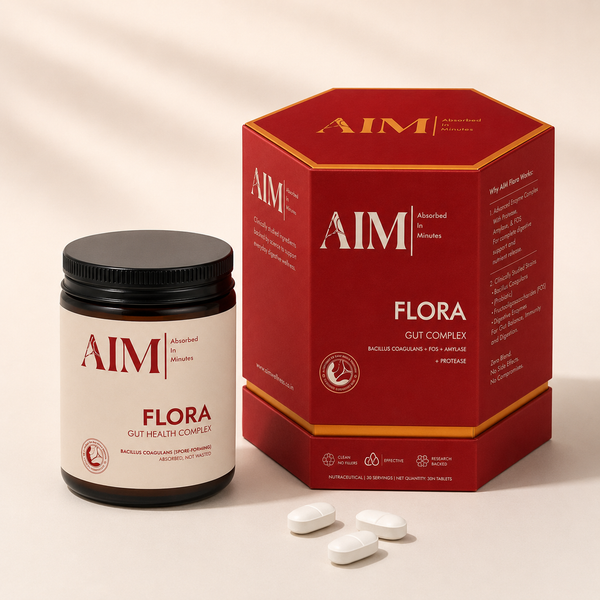
FLORA

A formula designed to work inside the gut

Not everything beneficial must enter the bloodstream. FLORA combines ingredients intended to perform different jobs in different parts of the digestive tract. Its science is therefore less about systemic absorption and more about survival, activity and location.

Three digestive zones. Three different jobs.

Upper digestive tractFood breakdown

Amylase, protease and bromelain are digestive enzymes. Their role is to help break larger food components into smaller ones. The enzymes are not the nutrients being "absorbed"; they help create smaller molecules that can subsequently be absorbed. For genuine transparency, enzymes should eventually be disclosed not only in milligrams but in recognised enzyme activity units, because equal weights can have very different activity.

Intestinal transitProbiotic survival

Bacillus coagulans can form a dormant spore, generally more resistant to environmental stress, acidity and bile than an unprotected vegetative cell. Under suitable intestinal conditions, spores may germinate and interact with the gut environment. PMC

ColonNourishment for the resident ecosystem

FOS is a prebiotic, not a probiotic. Human digestive enzymes do not fully break it down in the upper tract, allowing it to reach the colon where resident microorganisms can ferment it. Prebiotic effects are dose-dependent — a human study used 2.5, 5 and 10 g/day — so we do not call a FOS quantity a "clinical prebiotic dose" unless supported at that level. Nature

Survival is only the first question. The clinically meaningful questions are: which exact Bacillus coagulans strain is used, how many viable organisms remain at end of shelf life, whether the finished capsule (not the raw material) was tested for acid and bile survival, and whether the daily amount matches research on that exact strain.

"Bacillus coagulans" identifies the species — not the strain. Probiotic outcomes are generally specific to a defined strain, dose, population and outcome. Human IBS studies, for example, examined the specific strain B. coagulans MTCC 5856 at a defined daily CFU count; that evidence cannot automatically transfer to every product containing an unspecified B. coagulans. PubMed

We do not borrow the reputation of an entire species. Evidence must match the strain and dose inside the bottle.

Ginger — human studies suggest it can influence gastric contractions and gastric emptying, though findings and doses differ between trials. It is better described as supporting digestive comfort or movement than as guaranteeing faster digestion. PubMed

FLORA does not permanently replace your microbiome. It is designed to survive gastrointestinal transit and germinate under suitable intestinal conditions, interacting with and supporting the ecosystem already living there.

How we judge evidence

Not all scientific evidence is equally close to the product in your hand.

Level 1Finished-product human trial

The strongest evidence: the complete AIM formula tested in people.

Level 2Exact form or exact strain

Human research on the same magnesium form, probiotic strain and comparable daily dose.

Level 3Ingredient-family evidence

Research on magnesium generally, another B. coagulans strain, chamomile rather than isolated apigenin. Useful for rationale — not proof the finished product produces the same result.

Level 4Mechanistic or laboratory evidence

Cell studies, animal research, acid-survival experiments and proposed pathways. These explain how something might work; they do not prove a meaningful benefit in people.

Our standard: state what the evidence shows, identify what it does not show, and never present a mechanism as a guaranteed outcome.

What batch testing can — and cannot — prove

Batch testing can verify

  • Identity — is the material actually the ingredient and form stated on the label?
  • Potency — is the declared quantity present?
  • Purity & safety — microbial, heavy-metal and other contaminant limits.
  • Release — does the tablet or capsule disintegrate appropriately?
  • Stability — does potency remain within specification through shelf life?
  • Probiotic viability — does the declared CFU count remain at end of shelf life?

It cannot prove

…that every customer will sleep better, feel calmer, experience less bloating or respond within the same time.

A laboratory report proves what is in the bottle. A human clinical trial is needed to prove what the finished bottle does.

What we will never confuse

  • Absorption with effectiveness
  • A high label dose with a high usable dose
  • A species with a clinically studied strain
  • Laboratory survival with a guaranteed health outcome
  • Ingredient research with finished-product research
  • A biological mechanism with a promise

That is the real meaning of form-first formulation. Not simply choosing an impressive ingredient — but understanding every step between the bottle and the body.